LVMH is a global leader in luxury goods, headquartered in France, operating in over 80 countries with more than 75 prestigious brands.
According to the FM Global Invest Risk-Reward Rating, which evaluates companies across ten weighted categories—including business model quality, moat strength, financial health, dividend sustainability, and valuation—LVMH earns a total score of 73 out of 100, indicating a buy rating for the company. This positions it as a strong candidate for portfolios focused on global diversification, dividend growth, and financial resilience.
LVMH’s Business Model Overview
LVMH’s business model is built on owning and managing a collection of over 75 brands that operate across different segments like fashion, leather goods, watches, jewelry, perfumes, cosmetics, wines, and spirits.
Each brand under the LVMH umbrella operates with a high degree of autonomy. This means the creative and marketing teams of each brand can make their own decisions to maintain their unique identity. At the same time, LVMH provides strong financial support, operational discipline, and global reach, helping these brands grow while staying true to their essence.
Many of its products are sold at premium prices, which supports high profit margins. The company controls much of its own distribution—such as owning its own stores—instead of relying heavily on third parties. This gives it better control over the customer experience and brand image.
LVMH’s Competitive Advantages
-
Diversified Product Portfolio with strong Brands
LVMH owns a collection of strong brands with global recognition. Many, such as Louis Vuitton and Moët & Chandon, are leaders in their segments with very high entry barriers for competitors. -
Vertical Control and Scale
LVMH’s ownership of its production, logistics, and retail operations allows it to maintain premium positioning, adapt rapidly, and protect its margins. This integration supports pricing power and high returns on invested capital. -
Geographic and Segment Diversification
With sales spread relatively equally across Asia, the United States, and Europe, and across five business segments, the company is protected from isolated market downturns and shifting consumer preferences. -
Innovation
Retail and product innovations help LVMH maintain relevance among younger, digitally native luxury consumers. -
Financial Strength
Consistent cash flow generation, prudent debt management, and reinvestment enable LVMH to maintain its leadership position, fund innovation, and return capital to shareholders without compromising future growth.
LVMH according to the FM Global Invest Risk-Reward Rating
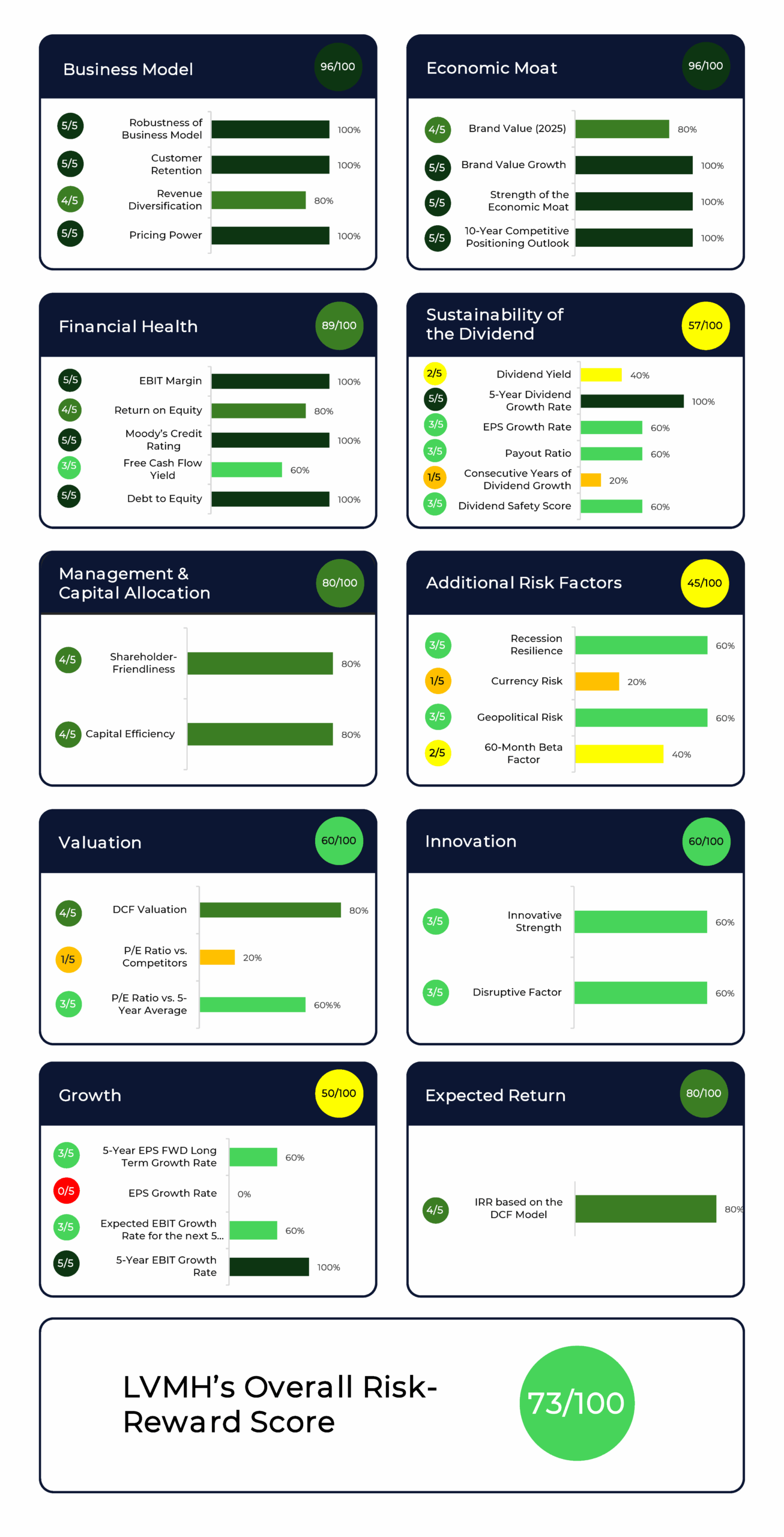
Here you can find a detailed explanation of the scoring system of the FM Global Invest Risk-Reward Rating.
Business Model – 96/100
LVMH operates a vertically integrated, multi-brand structure with leadership in Fashion and Leather Goods, Wines and Spirits, Perfumes and Cosmetics, Watches and Jewelry, and Selective Retailing. Revenue diversification across geographies and pricing power across core brands support strong business model resilience.
Economic Moat – 96/100
The company’s enduring competitive advantage lies in its unmatched portfolio of brands (including Louis Vuitton, Dior, Tiffany & Co., and Bulgari), heritage, and vertical control over design, production, and retail. It benefits from structural advantages that are exceptionally difficult to replicate. Continued expansion through flagship openings and experiential retail formats reinforces long-term market leadership.
Financial Health – 89/100
LVMH exhibits strong financial fundamentals. A solid EBIT margin of 23.12% and Return on Equity of 19.53% reflect operational efficiency and effective capital allocation. The Aa3 credit rating from Moody’s highlights low credit risk, while a Free Cash Flow Yield of 5.33% indicates healthy cash generation relative to market value.
Sustainability of the Dividend – 57/100
With a forward dividend yield of 3.20% and a robust 5-year CAGR of 15.77%, LVMH demonstrates a strong dividend growth track record. However, a payout ratio of 56.46% suggests a moderate buffer, making sustained growth dependent on continued earnings strength.
Management and Capital Allocation – 80/100
LVMH’s management focuses on building long-term value by reinvesting in the business and protecting brand quality. In 2024, the company invested about €5.5 billion into operations, including store upgrades, digital tools, and product development.
Acquisitions are carefully selected to strengthen key areas of the business, such as distribution or brand portfolio. At the same time, LVMH keeps its balance sheet strong and returns value to shareholders through dividend growth.
Additional Risk Factors – 45/100
The company’s scale and pricing power help mitigate cyclical risk but do not eliminate it.
Valuation – 60/100
LVMH trades at a premium relative to historical averages and industry peers. However, this valuation reflects its stability, reinvestment capabilities, and brand dominance. Compared to its peer group, LVMH deserves a premium Valuation, due to the company’s significant competitive advantages.
Innovation – 60/100
The company creates immersive brand experiences, such as exhibitions for Tiffany and Dior, to strengthen customer connections. In addition, LVMH leads in sustainable design, focusing on more environmentally friendly materials and production methods. These innovations help the company stay relevant for younger generations and protect the strength of its brands over time.
Growth – 50/100
Long-term growth remains supported by strong brand equity, global demand, and pricing power.
Expected Return – 80/100
My DCF Model, which assumes an EBIT Growth Rate of 5% and a perpetual growth rate of 3% afterwards, calculates an Internal Rate of Return of 11.45% for LVMH.
LVMH offers investors a strong combination of income growth and long-term capital appreciation potential.
Please note that this model is based on assumptions, and any changes to these inputs will alter the outcome.
Total Score: 73/100
This result positions LVMH as an attractive investment option for those seeking a high-quality company that provides income, growth, global diversification, and durable brand assets. LVMH presently receives a buy rating.
Who Should Consider Investing in LVMH?
LVMH is best suited for the following investor profiles:
-
Investors seeking long-term capital appreciation through brand compounding and pricing power.
-
Investors focused on dividend growth, rather than high current yield.
-
Those looking for high-quality, globally diversified companies.
I have recently added LVMH to The Dividend Income Accelerator Portfolio, our actively managed dividend portfolio, which aims to balance dividend income, dividend growth, and capital appreciation.
Allianz, which presently receives a score of 75 out of 100 on the FM Global Invest Risk-Reward Rating, was the other addition to our dividend portfolio this month.
Conclusion
LVMH earns a 73 out of 100 score on the FM Global Invest Risk-Reward Rating, reflecting strength across business model, economic moat, financial health, and capital allocation.
The company remains exceptionally well-positioned to deliver long-term value. For investors focused on quality, durability, and global brand leadership, LVMH represents a compelling long-term holding.
Author’s Disclosure: I have long term positions in the shares of Allianz and LVMH.