Apple stands as one of the most iconic and valuable companies in the world, known for its innovative products, ecosystem, and powerful brand. In this evaluation, we assess Apple through the FM Global Invest Risk-Reward Rating framework, which examines key dimensions such as business model strength, financial health, innovation, growth outlook, and dividend sustainability.
This analysis is based on Apple’s 2024 Annual Report as well as the company’s latest earnings results, and structured through our proprietary rating model. It provides a comprehensive view of Apple’s investment case for long-term investors.
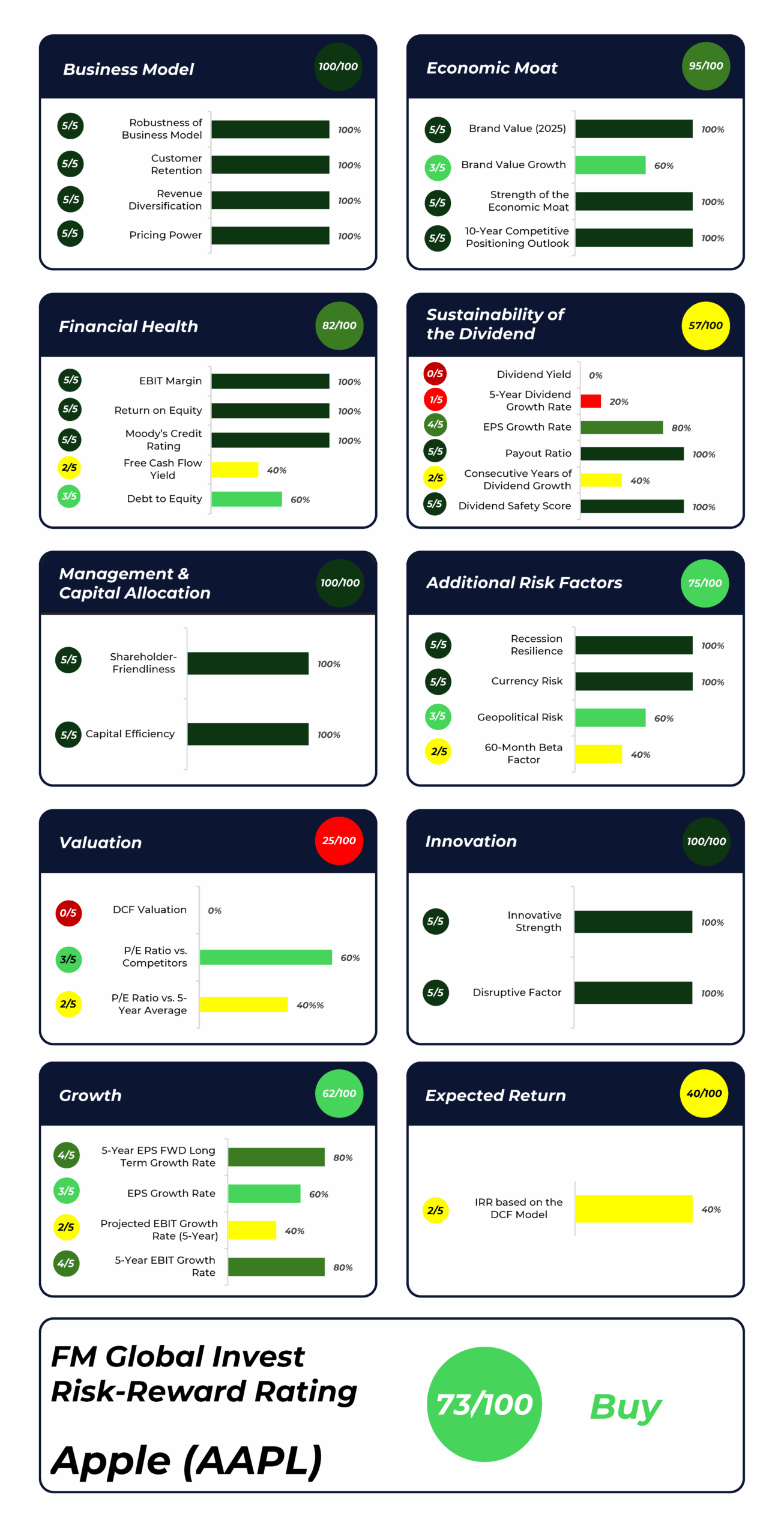
With a 73 out of 100 score, Apple is indicated to be an attractive risk-reward choice according to the FM Global Invest Risk-Reward Rating. Apple scores particularly well in the following categories:
- Business Model: 100 out of 100 Score
- Management & Capital Allocation: 100 out of 100 Score
- Innovation: 100 out of 100 Score
- Economic Moat: 95 out of 100 Score
- Financial Health: 82 out of 100 Score
Before we dive deeper into Apple’s evaluation using the FM Global Invest Risk-Reward Rating, it is essential to first understand how the company generates its revenue and what competitive advantages support its long-term success. These insights are critical for investors, as they reveal the durability of Apple’s business model, its ability to navigate changing market conditions, and its potential to deliver sustainable returns.
How Does Apple Generate Revenue?
1. Product Revenue
Apple designs, manufactures, and markets a variety of hardware products:
-
iPhone: Apple’s flagship line of smartphones, which remains the largest source of revenue.
-
Mac: A range of personal computers including MacBook Air, MacBook Pro, iMac, Mac mini, Mac Studio, and Mac Pro.
-
iPad: A line of tablets including iPad Pro, iPad Air, iPad, and iPad mini.
-
Wearables, Home and Accessories:
-
Wearables: Apple Watch, AirPods, Beats products, and Apple Vision Pro.
-
Home: Apple TV, HomePod, and HomePod mini.
-
Accessories: Includes Apple-branded and third-party accessories.
-
2. Services Revenue
Apple also earns revenue from a broad range of services, which includes:
-
Advertising: Income from Apple’s own ad platforms and third-party licensing.
-
AppleCare: Fee-based support services offering device protection and technical assistance.
-
Cloud Services: Includes storage and synchronization of data across Apple and Windows devices.
-
Digital Content and Subscriptions:
-
App Store: Revenue from app sales and in-app purchases.
-
Apple Music, Apple TV+, Apple Arcade, Apple News+, and Apple Fitness+: Subscription-based services offering music, video, gaming, news, and fitness content.
-
-
Payment Services: Apple Pay and Apple Card generate income from financial transactions and credit partnerships.
Apple’s Most Significant Competitive Advantages
According to Apple’s 2024 Annual Report, the company outlines several key competitive advantages that support its strong market position and long-term success:
1. Integration of Hardware, Software, and Services
Apple’s ability to design and integrate its own operating systems, hardware, application software, and services provides a seamless and differentiated user experience. This vertical integration strengthens customer loyalty and enhances product functionality across its ecosystem.
2. Innovation and Product Leadership
Apple invests heavily in research and development to create innovative products and technologies. Its leadership in areas like silicon design (e.g., Apple-designed chips), operating systems, and user interface design is a critical competitive edge.
3. Brand Strength and Customer Loyalty
Apple enjoys a highly recognized brand and deep customer loyalty, which is bolstered by its focus on design, privacy, security, and user experience. This contributes to strong repeat purchases and high customer retention across its ecosystem.
4. Ecosystem Lock-In
The interconnectivity between Apple devices and services creates a strong ecosystem lock-in. For example, customers using an iPhone are more likely to use AirPods, Apple Watch, and subscribe to Apple services like iCloud or Apple Music, reducing customer churn.
5. Global Distribution and Retail Network
Apple has a robust global supply chain and sales infrastructure, including a vast network of direct (retail and online) and indirect (third-party) channels, which helps it efficiently reach customers worldwide.
6. Financial Strength
With strong cash flow and substantial liquidity, Apple can invest in innovation, execute share repurchases, and weather economic downturns—giving it a strategic edge over competitors.
Apple According to the FM Global Invest Risk-Reward Rating
Here you can find a detailed explanation of the FM Global Invest Risk-Reward Rating.
Category-by-Category Analysis of Apple Based on the FM Global Invest Risk-Reward Rating
Business Model: 100 out of 100 Score
Apple’s vertically integrated business model is among the most robust in the world. By designing and controlling its own hardware, software, and services, the company creates a seamless ecosystem that drives recurring revenue, customer stickiness, and high satisfaction levels. Its end-to-end integration (from chips to cloud services) differentiates Apple and enhances long-term resilience and profitability.
Economic Moat: 95 out of 100 Score
Apple benefits from a wide and durable economic moat, rooted in its strong brand, proprietary technology, high customer retention, and ecosystem lock-in. Switching costs for users are high due to device and service integration, while the brand’s emotional connection with consumers gives it sustainable pricing power and repeat purchase behavior.
Financial Health: 82 out of 100 Score
Apple’s financial foundation is exceptionally strong. The company generates massive free cash flow, boasts one of the highest return on equity figures in the industry, and carries an Aaa credit rating from Moody’s. Its debt is strategically managed, and its balance sheet provides significant flexibility for investment, dividends, and buybacks.
Sustainability of the Dividend: 57 out of 100 Score
Apple’s dividend is highly sustainable. Despite a relatively modest yield, its low payout ratio, consistent earnings growth, and conservative capital structure ensure long-term dividend reliability. With over a decade of uninterrupted dividend increases and ample room for further growth, Apple offers dividend dependability for long-term investors.
Management and Capital Allocation: 100 out of 100 Score
Apple’s management demonstrates outstanding capital allocation discipline. The company consistently invests in innovation while returning capital to shareholders through dividends and one of the largest share buyback programs in history. This balance reflects strong shareholder alignment, long-term vision, and financial stewardship.
Additional Risk-Factors: 75 out of 100 Score
Key risks include Apple’s significant exposure to China (both as a supply chain hub and sales market), which introduces geopolitical and regulatory uncertainty. Currency volatility is another factor due to its international revenue streams. While the company actively mitigates these risks through diversification and hedging, they remain areas to monitor closely.
Valuation: 25 out of 100 Score
Given Apple’s slightly higher Valuation in comparison to its 5-Year Average, the company receives a lower Score in the Valuation Category.
However, Apple’s Valuation reflects investor confidence in its growth and stability. It trades at a premium to peers, supported by its superior margins, brand strength, and ecosystem.
Innovation: 100 out of 100 Score
Apple consistently ranks among the world’s most innovative companies. From custom silicon (e.g., Apple Silicon) to new platforms like Vision Pro, the company continues to push technological boundaries. Its sustained R&D investment and ability to redefine user experiences across categories support its long-term competitive edge.
Growth: 62 out of 100 Score
While Apple is a mature company, it continues to post solid growth in both earnings and free cash flow. Services and wearables are expanding rapidly, complementing a loyal base of iPhone users.
Expected Return: 40 out of 100 Score
Apple’s projected Internal Rate of Return suggests a moderately attractive risk-adjusted return profile, particularly for investors prioritizing capital preservation, dividend stability, and exposure to a high-quality, resilient business model. While the return potential may appear modest compared to higher-growth opportunities, the strength of Apple’s balance sheet, brand equity, and consistent cash flow generation justify its appeal for conservative, long-term investors seeking low-volatility equity exposure.
Strategic Alignment with The Dividend Income Accelerator Portfolio
Apple fits strategically into The Dividend Income Accelerator Portfolio due to its blend of dividend safety, growth potential, and low volatility. It helps balance high-yield positions with a durable growth compounder that enhances overall risk-adjusted returns while contributing to capital preservation and long-term wealth creation.
Who Should Consider Investing in Apple?
Apple is ideal for long-term investors seeking a high-quality, resilient company with consistent dividend growth, strong brand value, and defensive characteristics.
Key Risks to Monitor
- Geopolitical risk from China (manufacturing and regulatory exposure)
- Currency fluctuations affecting international earnings
- Regulatory scrutiny, especially around App Store practices and antitrust concerns
- Slower innovation cycles, if Apple fails to deliver the next wave of consumer tech adoption
Key Investor Takeaways
- Score according to the FM Global Invest Risk-Reward Rating: 73 out of 100
- Rating: Buy
- Suggested Allocation Limit: Up to 3% relative to the overall portfolio
Conclusion
Apple exemplifies a high-quality compounder that offers a rare combination of innovation, financial strength, and brand leadership. Its defensive characteristics and long-term earnings power make it an excellent core holding for diversified portfolios.
With a 73 out of 100 score, Apple remains an attractive risk-reward choice according to the FM Global Invest Risk-Reward Rating. According to our rating system, Apple is currently rated as a Buy.
For investors seeking a balance between growth and resilience, Apple remains a compelling choice that aligns well with the long-term goals of The Dividend Income Accelerator Portfolio. We plan to maintain Apple as a key position within our portfolio.
Author’s Note: I have a long term position in Apple.
Sources: Apple’s Annual Report 2024, Morningstar, Seeking Alpha.
Want to learn more about the FM Global Invest Risk-Reward Rating and how it evaluates other companies?
- Here you can find a detailed explanation of the FM Global Invest Risk-Reward Rating.
- Read our latest rating and analysis on Alphabet.
- Here you can find our latest rating and analysis on PepsiCo.
- Explore our latest rating and analysis about Allianz.
- Discover our latest rating and analysis on LVMH.
The FM Global Invest Risk-Reward Rating and how it evaluates ETFs
- Explore the detailed explanation of the FM Global Invest Risk-Reward Rating for ETFs.
- Discover our latest rating and analysis about the Schwab U.S. Dividend Equity ETF.